
Christmas Lights Tour Orange County: How to Get It Right
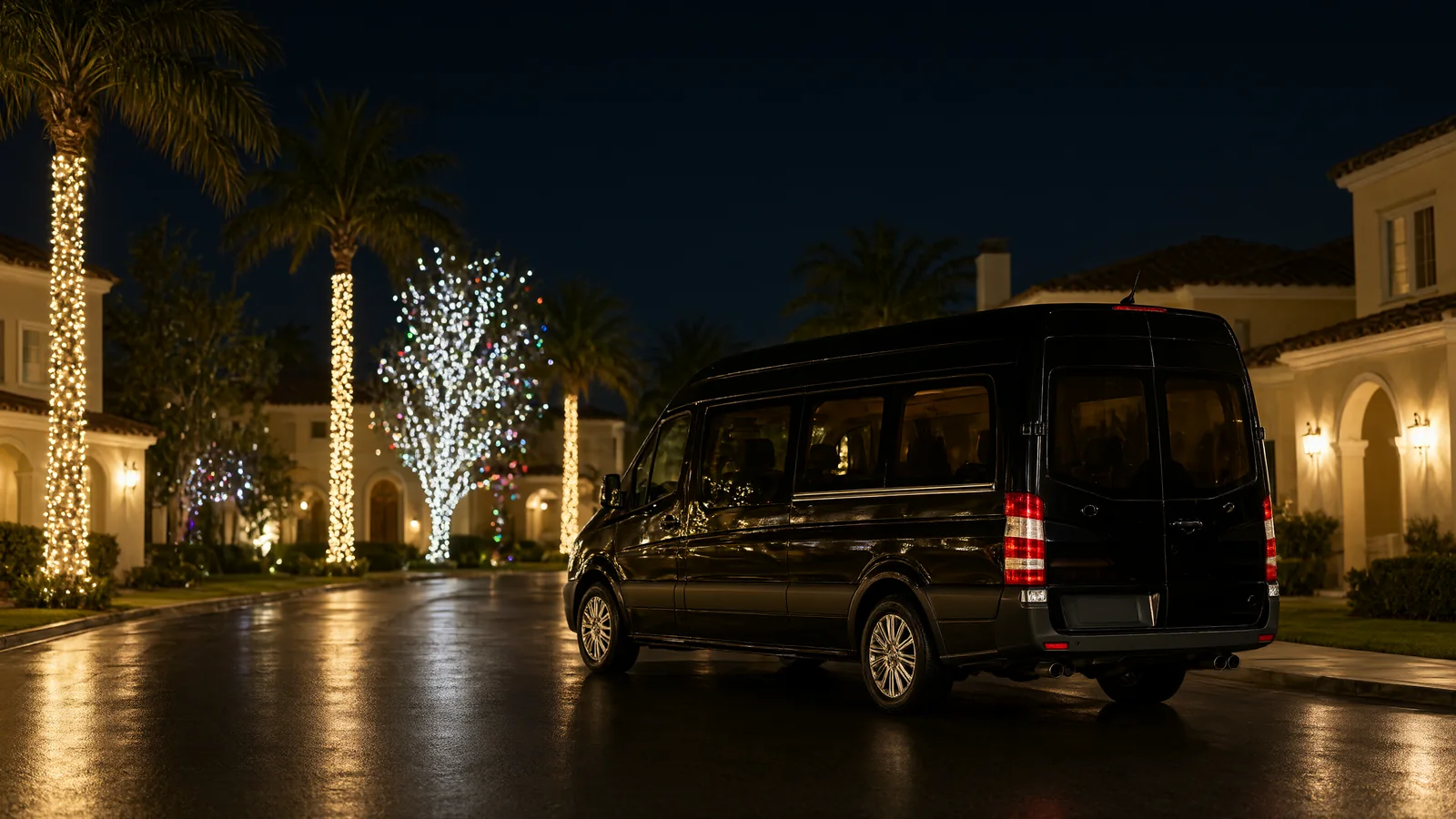
A Christmas lights tour in Orange County works on three decisions: go on a weeknight, start early in the evening, and book a vehicle that fits the street. Choose the area first. Confirm what is decorated this year before you pay. Then the driving is easy.
The timing decides more than the route
Every December the same call comes in: a Saturday, six people, can we still get a car. Sometimes yes. More often it is a different night.
The lights do not care when you arrive. The roads do.
| When | What the season looks like | What to do |
|---|---|---|
| Early to mid November | Usually very little is lit yet. December dates are being filled. | Choose the night and vehicle class. Settle the bedtimes. Call now. |
| Late November | The first displays usually go up, block by block. Plenty of streets are still dark. | Fine for a low-stakes early run. Do not judge the season by it. |
| First two weeks of December | Most displays are up in the areas people tour, though some streets stay dark. Traffic is busy but moving. | Good balance of lights, roads and availability. Book one to two weeks out. |
| Middle two weeks of December | Peak. Most decorated residential streets draw a line of cars. | Book earliest. Take a weeknight. Fix pickup points before the night. |
| Week between Christmas and New Year’s | Roads are quiet. Some displays have already come down. | Easiest driving of the month. Good for adults. Weaker if lights are the whole point. |
Weeknights beat weekends, and it is not close. On a Tuesday at 6:30 the same street that is gridlocked on a Saturday at 8 is a street you can drive. Weekend nights bring the locals, the visitors, the cars stopped in the lane with hazards on, and the kids between parked cars. In our experience, Newport takes the worst of it.
Early evening beats late for three reasons. Children are still awake at 6. Nobody has started asking how much longer. And you can cover two areas before 8 instead of sitting in one line until 9.
Start at 5:30 and you are home by 8. Start at 8 and you join everyone who ate first.
The car is the point, not the display
Four neighborhoods on foot in December means four parks, four dark walks, four rounds of “I’m cold”, and one adult standing in a loading zone while everyone else looks at lights. Coastal air after dark is damp. The kids are done before the second street.
In a car, the lights come to the window. The heater is on. Somebody else is watching the mirrors and hunting the space. Doors open where you stop, and the next area starts without a walk back to the car.
That is the product. Not a list of houses. If you are still weighing a car, a van and a bus, the sizing guide settles it faster than a phone call.
The areas people actually drive
These are areas, not addresses. What is lit changes every year, because homeowners opt in and out. Treat every name as a starting point and confirm before you book.
- Naples Island, Long Beach. Canal-front residential streets, bridges, water on both sides. Narrow, and busy on weekends. What is lit changes year to year, so check before you commit.
- Balboa Island and the Balboa Peninsula, Newport Beach. Island streets plus the peninsula. Tight, parked-up and slow. Confirm what is running this season rather than trusting a post from last December.
- Dana Point Harbor. The harbor runs an annual holiday boat parade, and the decorated boats are the draw. Dates move each year, so confirm the current year’s arrangements with the organizer.
- Crystal Cove and Corona del Mar. Coastal areas where some streets and cottages decorate, with the ocean behind them. Displays vary year to year, and Crystal Cove sits inside a state park, so access is not the same as a residential street. Ask before you plan a stop.
- Old Towne Orange and downtown Fullerton. Walkable districts rather than residential loops. Check which blocks are decorated this year before you build a stop around one.
Five areas is not five stops in one night. Pick two, maybe three if they sit close. Long Beach to Dana Point is a drive, not a hop, and that drive eats a four-hour booking. None of this is a promise about a particular street this year.
The route problem
The streets people come to see are residential, laid out for the people who live on them: narrow streets, cars parked on both sides, one-way loops, cul-de-sacs, and corners with a wall or a hedge on the inside. Some have no turning circle at all except a driveway.
This is where the vehicle stops being a preference. A full-size party bus needs a wide arc to finish a turn, and clear road to swing it. On a narrow one-way residential street with a car parked on each side and people on the corner, that arc is often not there. What our chauffeurs do instead: back up, three-point in front of an audience, or skip the street.
A Sprinter usually gets through where the bus does not. Same chauffeur, same route, and the van reaches the streets people came for. That is operator observation from running these streets in December, not a manufacturer’s limit. The difference is width and turning circle on roads built long before anyone booked a bus, and it shows up hardest on the narrow one-way loops.
Where a car can stop is a separate question, and it shifts with the crowd, the parking and the city. A chauffeur may adjust the route on the night. The Sprinter page covers the interior and the door arrangement.
Then parking. On a Saturday in December, parking near the popular areas is close to nonexistent. The car sits in line while a family of six walks the last two blocks, and the clock runs.
The fix is pickup points, not addresses. A corner two blocks off the busy street, where a car can stop without blocking a lane. Send the pin. Otherwise the chauffeur circles the block while four people stand in four different places.
Keep the idling short. People live here, and a large vehicle running outside a house at 8pm is one way a street ends up off the list for tours.
Kids are the actual audience
Two hours is the right tour for a five-year-old. Four hours is not.
Two hours covers one area properly. Four covers three, and somewhere in the third the back seat stops looking out of the window.
Car seats first. Ask at booking whether the operator supplies one or you bring your own, and give the ages on the call. A booster that lives in your garage does not help if nobody planned for it.
Bathrooms second. Somebody needs one forty minutes in, usually the smallest person, usually just after you leave the first stop. Build one stop with a real bathroom into the route. A coffee shop, a hotel lobby, a harbor building. Not a gas station on PCH on a Saturday in December.
Feed them before pickup. Cocoa in the car is a treat. Dinner in the car is a stain.
A blanket each, and a window seat rotation so nobody spends the night behind a pillar. No opening the door until the chauffeur says so.
Drinks: bring the cocoa, ask about the rest
Bring your own cocoa. A thermos travels better than a cup with a lid and stays hot for the whole loop. Marshmallows in a bag, not in the flask.
Alcohol is a separate question, and the honest answer is that it depends on the operator and the vehicle. Some allow it, some do not, and the conditions differ. Ask when you book instead of assuming. The legal drinking age in California is 21, and it applies inside the car. That is the one line that does not vary.
What to bring, what to wear, what not to do
Bring a thermos each, a blanket for the smallest passenger, a charged phone, and one person to hold the pickup pin.
Wear layers and flat shoes. December evenings on the coast are usually colder than the afternoon suggests, and damp by 7pm. Heels are fine in the car and miserable on a dark sidewalk.
Do not stop in a live lane to take a photo, ask the chauffeur to hold a spot in front of somebody’s driveway, open a sunroof on a residential street, or walk into a front garden for a better angle.
When a lights tour is the wrong booking
A family of four doing one neighborhood does not need a chauffeur. Drive, park two streets away, walk the block, go home. The booking adds a booking minimum, a pickup window and a fixed end time to a ninety-minute trip.
A group that wants to walk every stop is buying the wrong thing. A car is not a walking tour with a heater. If the plan is to get out at six places and stroll each one, you will spend the night watching the clock.
Two other cases. A group treating it as a bar crawl with lights in the background: that is a party bus night. And a group that wants a narrator and the history of each neighborhood: book a walking tour. We drive. We know the streets. We are not a guide.
Questions people ask before booking
When do Christmas lights go up in Orange County?
Displays start appearing in late November and most are up by early December in the areas people tour. Homeowners set their own timing, so confirm what is decorated in the area you want before you book. It changes every year.
How long is a Christmas lights tour?
Two hours covers one area properly, or two if they are close. Three hours covers three areas with a bathroom stop. Four hours is a lot of sitting for young children. Most families do better shorter.
Is a party bus or a Sprinter better for a lights tour?
A Sprinter, in most cases. The streets with the lights are narrow, often one-way, and short on turning space. In our experience a full-size bus often cannot complete some of those turns, and a Sprinter usually can. Save the bus for a group that wants the bus itself as the venue.
Can we bring drinks on a Christmas lights limo?
Cocoa, coffee and soft drinks, yes. Alcohol depends on the operator and the vehicle, so ask at booking rather than assuming. The legal drinking age in California is 21, and it applies inside the car.
What time should we start a lights tour?
Between 5:30pm and 6:30pm, on a weeknight. That gets you into the first area before the evening traffic builds, keeps younger children awake, and leaves room for a second stop.
Are the Balboa Island lights up every year?
The island decorates most years, but homeowners opt in and out, and the streets worth driving change. Check the current season before you book. Any list from a previous December is a guide, not a schedule.
Book the night, not the list
A good lights tour is not the one that hits the most streets. It is the one where nobody is cold, nobody is lost, and the car is waiting where you agreed.
Call (714) 313-9173 with the date, the number of people, the ages of any children, and the two areas you want. Dispatch answers around the clock and will tell you honestly which night is quieter. We have run chauffeured cars out of Stanton since 2002, across 24 Orange County cities.
If Newport is the plan, the Newport Beach page covers the local ground. For a group that turns into a party, private events and parties is the right starting point. Prefer to write it down? The contact page works.
Frequently Asked Questions
Displays start appearing in late November and most are up by early December in the areas people tour. Homeowners set their own timing, so confirm what is decorated in the area you want before you book. It changes every year.
Two hours covers one area properly, or two if they are close. Three hours covers three areas with a bathroom stop. Four hours is a lot of sitting for young children. Most families do better shorter.
A Sprinter, in most cases. The streets with the lights are narrow, often one-way, and short on turning space. In our experience a full-size bus often cannot complete some of those turns, and a Sprinter usually can. Save the bus for a group that wants the bus itself as the venue.
Cocoa, coffee and soft drinks, yes. Alcohol depends on the operator and the vehicle, so ask at booking rather than assuming. The legal drinking age in California is 21, and it applies inside the car.
Between 5:30pm and 6:30pm, on a weeknight. That gets you into the first area before the evening traffic builds, keeps younger children awake, and leaves room for a second stop.
The island decorates most years, but homeowners opt in and out, and the streets worth driving change. Check the current season before you book. Any list from a previous December is a guide, not a schedule.