
What Time to Leave for the Airport in Orange County
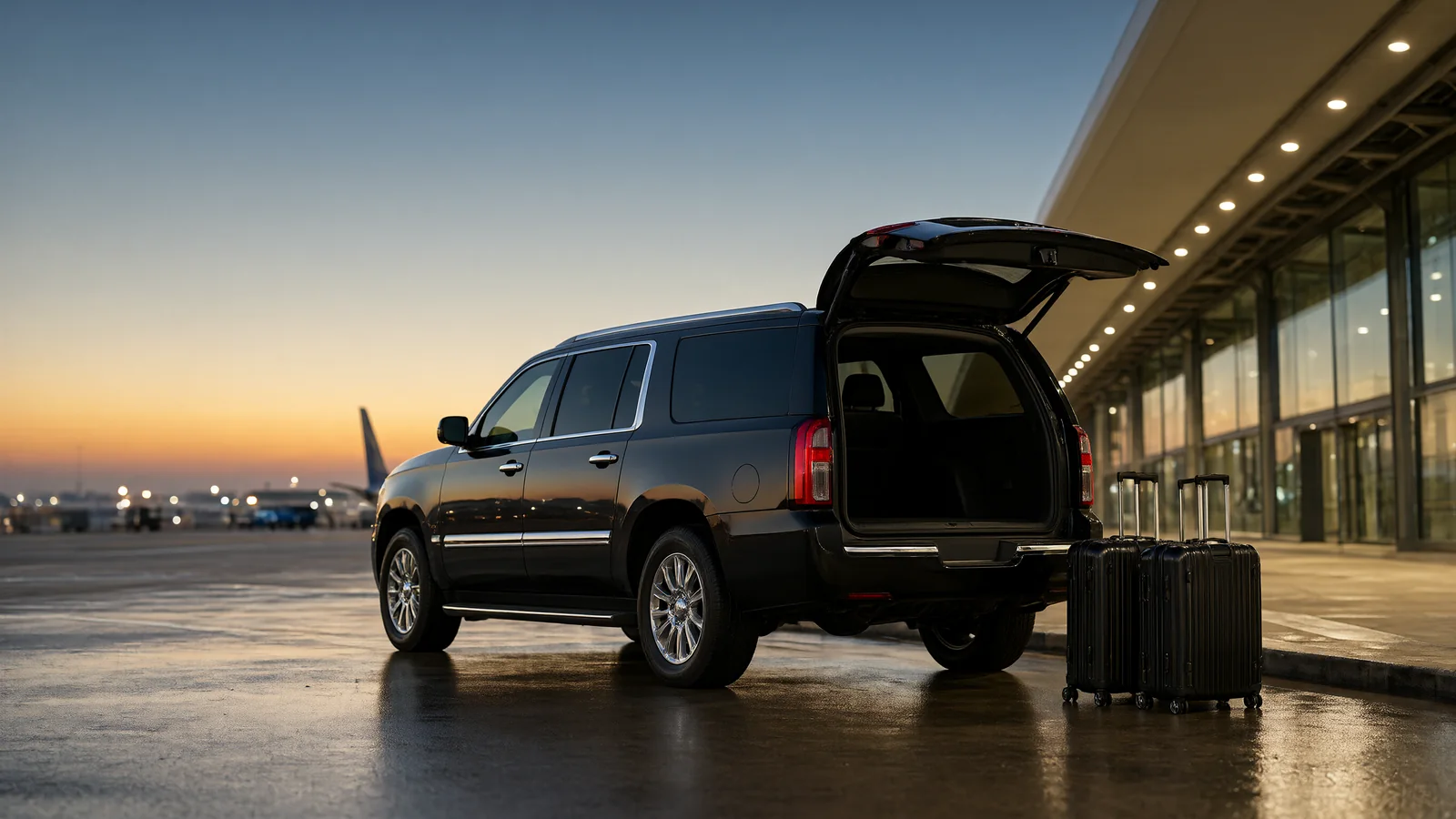
For a 9am domestic flight from John Wayne, leave central Orange County around 7:15am. The same flight out of LAX needs about 6:10am. Those times include a checked bag, and the gap is drive time and terminal size, not the flight time. International adds about an hour and a quarter.
That is the short version. The rest of this is how you get to your own number, because “arrive two hours early” is arrival guidance. It is not a departure time, and the difference between those two things is where flights get missed.
We run airport transfers out of Stanton seven days a week and have since 2002. There is a pattern in the calls that come in at 5:40am sounding tight. Almost none of them are about traffic. They are about a person who planned for one clock and got caught by another.
The three clocks, and the one everybody watches
A departure involves three separate deadlines, and they do not arrive together.
The bag cutoff. Most airlines close checked-bag acceptance 45 minutes before departure, as a general rule rather than a promise. Miss it and you are not late for a flight, you are off it, even if you are standing at the counter. This is the earliest hard stop in the whole sequence and the one people underestimate most.
Security. No fixed number. It moves with the hour, the terminal, and how many lanes are open. TSA PreCheck changes it. So does a holiday Monday.
Gate close. Commonly 15 minutes before departure. Boarding starts before that, and on a full flight your seat assignment stops meaning much once the door shuts.
Here is the thing. Most people plan for security, because it is the visible part, the line you can see. The clock that actually ends trips is the bag cutoff, which happens before security and gives no warning. You cannot see it from the queue. You find out at the counter.
So the calculation runs backwards from wheels-up, and it passes through the bag cutoff first. Not last.
Work backwards, in this order
Six numbers. That is the whole method.
- Wheels-up. The scheduled departure time. Not the boarding time, not the “be there by” time on your confirmation email.
- Gate close. Subtract 15 minutes. This is the latest you can physically walk on.
- At the gate. Subtract another 10 to 15 for boarding. Being at the gate when the door closes is not the goal.
- Security and the walk. Subtract your allowance. This one is a range, not a number, and it varies by airport more than anything else in the list.
- Bag drop. Subtract 15 to 25 minutes if you are checking anything, plus the cutoff check from step one.
- The drive. Subtract the realistic range for that hour on that freeway, then decide when to leave.
Then add the buffer you actually want. Ten minutes if you are relaxed about it. Twenty if you are not.
What falls out is your leave time. What most people do instead is start at the flight time, subtract two hours because TSA says so, and stop. That number ignores the drive entirely, which is the largest single variable in Orange County. TSA’s two hours is general advice for the airport, and it is good advice. It was never a departure time.
Two 9am flights, two different answers
A 9:00am domestic departure. Same flight time, same passenger, same suitcase. Two airports.
| Backwards from wheels-up | 9:00am from SNA | 9:00am from LAX |
|---|---|---|
| Wheels-up | 9:00am | 9:00am |
| Gate closes (15 min before) | 8:45am | 8:45am |
| At the gate, boarding done (15 min) | 8:30am | 8:30am |
| At security, walk to gate included (SNA 30 min, LAX 55 min) | 8:00am | 7:35am |
| At the bag drop, if checking (20 min) | 7:40am | 7:15am |
| Leaving your door (drive 25 min to SNA, 65 min to LAX) | 7:15am | 6:10am |
Same flight. Sixty-five minutes apart, and the table says exactly where the difference sits: forty minutes more on the road and twenty-five minutes more inside the terminal. The bag row is identical, because a suitcase takes the same twenty minutes to tag wherever you are standing.
If every range lands at its bad end, the same arithmetic gives 6:50am from SNA and 5:35am from LAX. The spread is why this is a calculation and not a rule.
Run the LAX column down and the reason is not subtle. The security allowance adds about twenty-five minutes, because LAX is a large airport with a terminal loop, and the loop alone can eat twenty minutes on a bad morning. The drive more than doubles. Nothing about the flight changed. Everything about the airport did.
Where this bites is the 9am departure that gets moved from SNA to LAX three weeks out because the nonstop went away. The flight time is identical. The alarm is not. If you booked the car before the schedule change, call and move it.
The four airports, one table
Distances are approximate road distance from central Orange County, roughly the Anaheim and Irvine band. “Be inside” means inside the terminal, past the doors, not in the parking structure.
| Airport | About how far | Be inside the terminal (domestic, checking a bag) | Add for the drive, normal weekday |
|---|---|---|---|
| SNA, John Wayne | about 15 miles | 75 to 90 min before wheels-up | 20 to 35 min |
| LGB, Long Beach | about 25 miles | 90 min before wheels-up | 30 to 45 min |
| LAX | about 35 miles, more from south county | 2 hours before wheels-up | 50 to 80 min |
| ONT, Ontario | about 35 miles east | 2 hours before wheels-up | 50 to 85 min |
Read the last two columns together. They are separate numbers on purpose, because the airport time and the road time fail independently.
This table is the padded version, the number to remember when you do not want to do arithmetic. The two-airport table above is the same thing with the working shown, and the two land within about twenty minutes of each other. LAX and ONT sit on TSA’s two hour figure because both are large enough that the general advice holds. SNA and LGB are small enough that 75 to 90 minutes usually covers it, though two hours is the safer call with bags, on a holiday weekend, or the first time you fly out of there.
Every drive figure above assumes a normal weekday and nothing going wrong. Check live traffic before you leave. One SigAlert on the 405 removes the assumption entirely, and the table cannot help you with that. If the roads are bad, the answer is earlier, not faster.
Add an hour to the “be inside” column for an international departure. At LAX and ONT that lands on TSA’s three hours.
The traffic windows
Not timings. Patterns, because a number here would be wrong on most days.
Morning outbound. The window where the county empties toward Los Angeles. This is the one that decides early flight bookings. It is also the window where a car that moves fine at 10am does not move fine at all.
Evening inbound. The reverse. If you are landing at LAX at 5pm and heading south, the drive is a different animal than the morning version of the same route.
Four freeways do most of the damage, and they fail differently:
- The 405 runs the spine of the county, past Costa Mesa, Irvine, Fountain Valley, Westminster and Seal Beach, and continues north toward LAX. Northbound in the morning is the problem. Southbound in the evening is the problem. Both are the LAX route.
- The 5 handles Anaheim and the north county, and the Orange Crush, where it meets the 22 and the 57, does damage in both directions. North of the 55 the usual LAX run is the 5 to the 91 or the 605, then west on the 405 or the 105.
- The 55 is short and does more work than its length suggests. It runs from the coast at Newport Beach up through Costa Mesa, crosses the 405, then the 5, and ends at the 91 in Anaheim. The 405 end backs up in the morning and takes the whole road with it.
- The 91 carries the Riverside traffic east and west. Westbound in the morning, eastbound in the evening, with the Corona stretch doing most of the damage. Anyone in the Yorba Linda or Anaheim Hills corner meets it first.
SNA sits inside all of this rather than across it, which is why the 15 miles is survivable. ONT is the opposite. It sits out east past the 57 and the 71, served by the 10 and the 60, so a morning run where everyone else is coming west has the road mostly to itself going out.
The parking tax
Nobody counts this, and it is real minutes.
Drive yourself and the timing does not stop at the parking structure entrance. It continues through the queue at the gate, the search for a space on an upper deck, the walk to the elevator, the wait for the shuttle or the longer walk to the terminal, and then the bag drop you already accounted for. At LAX that sequence commonly adds 30 to 45 minutes on a busy morning. At SNA it is closer to 15 to 25, because the structure is close and the walk is short.
Now count it. If parking costs you 40 minutes at LAX, those 40 minutes come off your alarm clock, not off the drive. The same 9am flight that needed a 6:10am departure from the curb needs a 5:30am departure from your own driveway.
That is the case for a black car on an early flight, and it is arithmetic rather than a pitch. A chauffeur drops you at the terminal and leaves. No structure, no shuttle, no walk from row 14.
It also does not automatically win. Two people with carry-ons on a midday SNA flight? Driving yourself is a reasonable call, and the parking tax is small at that airport. The math flips on early departures, on LAX, on checked bags, and on groups. Those four conditions decide it, not the brand of the car.
International departures
Different calculation, not just a longer version of the domestic one.
TSA advises arriving three hours before an international departure. That is the floor, not the plan, and it assumes you already know where you are going inside the terminal.
Three things stretch it further. Airlines commonly set a longer checked-bag cutoff for international itineraries than the 45 minutes many use domestically, so the hard stop moves earlier. Document checks at the counter take longer than a domestic bag tag, because someone has to look at a passport and sometimes a visa. And international departures often leave from gates with long walks.
From central Orange County to LAX, that usually lands you leaving about four hours before wheels-up, sometimes more. It is a long time to sit at a gate. It is shorter than rebooking.
Red-eyes and early mornings
This is where the airport choice stops being about convenience and starts being about what time the first departure exists.
SNA does not run a full overnight departure schedule the way LAX does. So the late departures mostly come out of LAX, and that changes the booking before it changes the car. People who would never choose LAX for a 9am flight choose it without thinking for a red-eye, because there is no alternative at that hour.
Two consequences for timing. The roads are clearer at that hour, so the drive is at the bottom of the range. But the terminal is not empty the way people expect, and bag drop counters are not fully staffed all night. Leave earlier than the empty freeway suggests.
The same logic runs in reverse on arrivals. A flight that lands at LAX at 5am needs a car at 5am, and that is a booking made days earlier, not a rideshare requested from the curb.
Groups and luggage
Vehicle choice is a timing decision when there are more than three people.
Three sedans means three pickup addresses, three loading sequences and three arrival times that have to line up. One larger vehicle means one stop. That difference is usually worth more minutes than the drive itself, especially at 5am when each passenger is a separate doorbell.
Luggage matters for the same reason. A group that fits in one vehicle with the bags in the back loads in five minutes. A group that fits in one vehicle without the bags needs a second car, and a second car needs its own fifteen minutes.
The sizing question is answered properly in which limo do I need for your group. For larger parties, the shuttle van service and the Sprinter limo are the two that come up most often on airport runs, and both change the load time rather than the drive time.
Add 10 to 15 minutes to the pickup time for every extra stop beyond the first.
What to tell dispatch
Give us five things when you book, and the timing works itself out:
- Flight number. This is the one that matters most. It tells us the airline, the terminal and the real departure time, and it lets us track the flight rather than guess at it.
- Airline and terminal, if you already know them. Useful when a flight number changes or a carrier moves terminals.
- Bag count. Checked bags change the arrival allowance, and a family with six suitcases loads differently from two people with carry-ons.
- Passenger count, including children and car seats.
- Anyone who needs extra time walking. Say it plainly. An extra ten minutes on the front end is easy to plan and impossible to invent at the curb.
If you are not sure what time to set the pickup for, give us the flight number and the city you are leaving from. We will work the same backwards calculation and set the time. That is a normal request, not an imposition, and it is better than a pickup time you guessed at.
Our airport transportation service covers SNA, LAX, LGB, ONT and the rest, and we serve 24 Orange County cities. Dispatch is on the phone around the clock.
Frequently asked questions
How early should I get to John Wayne Airport?
For a domestic flight from SNA, be inside the terminal 75 to 90 minutes before wheels-up if you are checking a bag, which covers the bag cutoff, security and the walk to the gate. TSA’s general advice is two hours before a domestic departure. Use that two hour figure if you are flying international, checking several bags, or travelling on a holiday weekend.
Is it faster to fly into SNA or LAX?
Flying into SNA is faster if you are staying in Orange County. The airport is about 15 miles from central Orange County and small enough to walk in minutes. LAX is about 35 miles away, more from south county, and the terminal loop and freeway traffic can add an hour or more on a normal weekday.
What time should I leave for a 6am flight from Irvine?
From Irvine, leave about 4:20am for a 6am domestic flight from SNA, and about 3:10am for the same flight from LAX. The gate closes at 5:45am, you want to be at it by 5:30, security runs about 30 minutes at SNA and 55 at LAX, a checked bag takes 20, and the drive is roughly 25 minutes to SNA and 65 to LAX. Verify live traffic before you go, because one closure changes the answer.
Does a limo wait if my flight is delayed?
On airport pickups, dispatch tracks the flight number, so a delayed arrival moves the pickup with it. Give the flight number when you book, not the time you expect to land. For departures, the pickup time is yours to set, so build the buffer in before you book rather than asking the driver to make it up.
How early should I leave for an international flight from LAX?
Plan on being inside the terminal three hours before departure, which is what TSA advises for international travel. Airlines commonly set a longer checked-bag cutoff for international itineraries, and document checks at the counter take longer. From central Orange County that usually means leaving about four hours before wheels-up, give or take twenty minutes.
Do I need a different departure time for a red-eye?
Yes, because the airport changes. SNA does not run a full overnight departure schedule the way LAX does, so late-night flights usually mean LAX. Roads are clearer at that hour, but the drive is longer and the terminal is busier than people expect. Leave earlier than the empty freeway suggests.
Set the pickup time once, correctly
The number you want is not on your confirmation email. It comes from your wheels-up time, your airport, your bag count and the hour you are driving through the county.
Call dispatch at (714) 313-9173 with the flight number and the address. We will work the calculation, set the pickup, and track the flight. If you would rather write it out, the contact page takes the details, including the ones people forget, like the extra ten minutes for a passenger who walks slowly.
For the Anaheim to LAX run specifically, there is a fuller route breakdown in our LAX limo service from Anaheim guide. The timing math is the same. The freeway detail is not.
Frequently Asked Questions
For a domestic flight from SNA, be inside the terminal 75 to 90 minutes before wheels-up if you are checking a bag, which covers the bag cutoff, security and the walk to the gate. TSA's general advice is two hours before a domestic departure. Use that two hour figure if you are flying international, checking several bags, or travelling on a holiday weekend.
Flying into SNA is faster if you are staying in Orange County. The airport is about 15 miles from central Orange County and small enough to walk in minutes. LAX is about 35 miles away, more from south county, and the terminal loop and freeway traffic can add an hour or more on a normal weekday.
From Irvine, leave about 4:20am for a 6am domestic flight from SNA, and about 3:10am for the same flight from LAX. The gate closes at 5:45am, you want to be at it by 5:30, security runs about 30 minutes at SNA and 55 at LAX, a checked bag takes 20, and the drive is roughly 25 minutes to SNA and 65 to LAX. Verify live traffic before you go, because one closure changes the answer.
On airport pickups, dispatch tracks the flight number, so a delayed arrival moves the pickup with it. Give the flight number when you book, not the time you expect to land. For departures, the pickup time is yours to set, so build the buffer in before you book rather than asking the driver to make it up.
Plan on being inside the terminal three hours before departure, which is what TSA advises for international travel. Airlines commonly set a longer checked-bag cutoff for international itineraries, and document checks at the counter take longer. From central Orange County that usually means leaving about four hours before wheels-up, give or take twenty minutes.
Yes, because the airport changes. SNA does not run a full overnight departure schedule the way LAX does, so late-night flights usually mean LAX. Roads are clearer at that hour, but the drive is longer and the terminal is busier than people expect. Leave earlier than the empty freeway suggests.