
Anniversary Limo Service Orange County: The Timing Problem
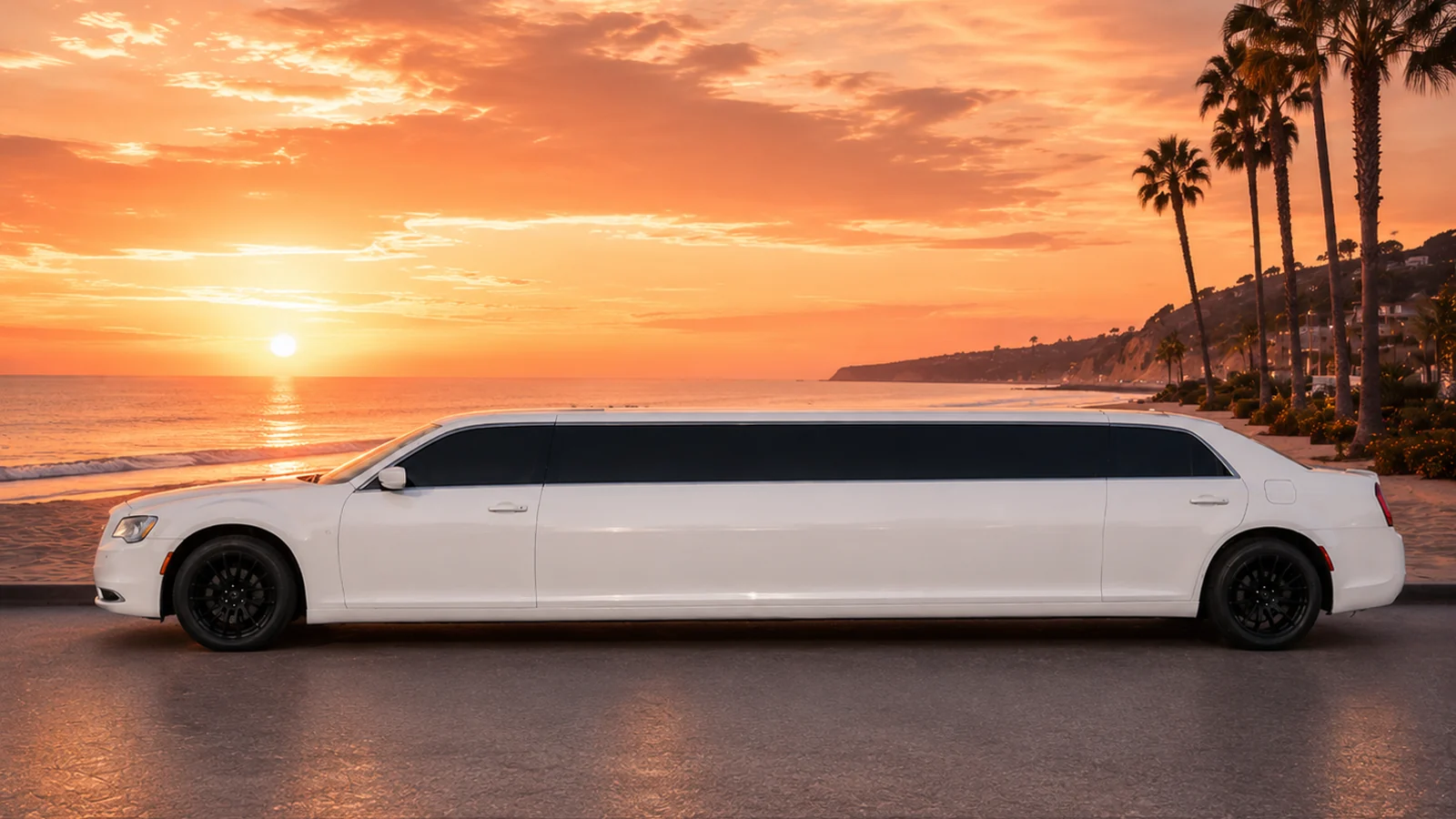
An anniversary or proposal limo in Orange County works when the booking is built around the fixed parts of the evening: the reservation, the light, the moment itself, and the drive between them. The car is the only part that can move. Plan the rest first, then give the operator the times.
That order matters more than the vehicle. Most of the calls we take are not “which car.” They’re “we have a 7:00 table and we want to propose before dinner.” Those two facts sit 20 minutes apart on a good night and an hour apart on a Saturday in June, and nobody has checked which.
The four things that have to line up
Every anniversary and proposal run we drive comes down to four fixed points. Three of them are yours to set. One belongs to the sky.
| Fixed point | What it actually is | Who controls it |
|---|---|---|
| Reservation time | A table held for a limited window, not the whole evening | You, when you book |
| Sunset | The end of usable daylight, moving about an hour across the year | Nobody |
| The ring or gift | A small object that has to be in the car, not in a drawer at home | You, that morning |
| The drive | Traffic, parking, the walk from the door to the table | The chauffeur, if briefed |
The failure is almost never the car. It’s the order. People book the restaurant, then book the car, then remember the ring is still in a drawer, then discover the light is gone by late afternoon in November when they wanted photographs outside.
Work it the other way. Pick the date. Check when the sun goes down on that exact date, because sunset in Southern California moves by about an hour across the year and the same clock time is bright in July and dark in December. Then set the reservation. Then give the car a window that covers both, with slack at the end.
The proposal problem
If someone is going to cry, the plan has to survive it.
Not the tears themselves. The time they take. The moment people picture is 90 seconds: down on one knee, yes, hug. What actually happens runs longer. There’s the pause before the question, the silence after the yes, the phone call to a parent, the second round of crying when the ring is looked at properly, and the photographs taken by whoever is standing there. In our experience, twelve to twenty-five minutes is common. We’ve waited longer.
So the car needs somewhere legal to be for half an hour. Not a turn lane. Not a red zone with the hazards on and the chauffeur watching the mirror for a parking officer. A proposal spot with a view is often a small lot or a wide shoulder that fills up at sunset. The difference between a good version and a bad one is whether somebody checked that spot in daylight, in advance.
Here’s the part that gets skipped. Tell the chauffeur before the partner knows.
Tell them on the phone when you book, in plain language. Where the car should be. Whether it stays or drives around and comes back. How long you expect to be. What the signal is when you’re ready. Some people text. Some people turn and wave. Decide which before the night, because a chauffeur who has to guess will either hover too close or disappear at the wrong minute.
If a friend is hiding with a camera, say so. Otherwise a stranger steps out of the dark toward a couple and the chauffeur has to make a judgment call in three seconds. Give the car a description of the person, or give the person the plate.
One more thing. The partner hears the briefing if it happens in the car. Do it on the phone, in a message, or in the two minutes while the partner is still inside the house getting ready.
Restaurant timing
Restaurants hold a table for a limited window. As a rule, most hold it about 15 minutes past the reservation, and a busy room on a Saturday is stricter than a quiet one on a Tuesday. That’s general restaurant behavior, not a promise from any particular one.
Now the arithmetic of 7:00 against 7:20.
At 7:00, the valet line at a busy place is not a line. It’s a queue of cars waiting for one attendant who is also moving cars out of the drive. In general, ten minutes to reach the door is common. Then the walk, the greeting, the seating. If your reservation is 7:00 and the car pulls up at 7:00, you sit down at 7:12, and the table has been empty for twelve minutes while the host decides whether you’re coming.
At 7:20 on a Saturday, the table is often gone or squeezed. The restaurant isn’t being cruel. It has a second seating later and a walk-in list at the door.
The workable version is to arrive at the curb ten minutes before the reservation and let the car absorb the valet queue. You step out at the door. The chauffeur deals with the rest.
Where it gets tight is a proposal scheduled 30 minutes before a dinner reservation. Thirty minutes is usually enough for the question. It’s not enough for the question plus the crying plus the photographs plus the drive. Either move the dinner later or accept that the moment gets cut short by a clock. The car can wait. A table can’t.
The photo window
Twenty minutes is the number to plan for.
Not because photographs take twenty minutes. It’s because the usable light at the end of the day is short, and twenty minutes is a realistic slice of it. Short enough to book, long enough to be worth booking.
Build it into the run as a stop with a start time. Not “we will find somewhere.” A stop means the chauffeur knows the place, knows where to put the car, and knows you’ll be back in twenty minutes. It also means a photographer has a time and a place rather than a text at five in the afternoon asking where you are.
Two practical notes. First, check sunset for your date. The window moves through the year, and a plan built for summer light fails in December. Second, decide what happens if it’s overcast or raining. The light goes earlier and the stop becomes a five-minute look rather than a twenty-minute shoot. Have a fallback that’s indoors or covered, or accept that the photographs happen at the restaurant.
If there’s no photographer, a chauffeur can take a phone picture. Ask when you book, not while it’s happening. It’s a small thing that goes wrong in a very visible way when it’s improvised.
The surprise logistics
A surprise has a small number of people in it, and the number matters.
The people who should know: whoever books, dispatch, the chauffeur, and one friend if a friend is involved. That’s usually the whole list. The people who shouldn’t: the partner, the partner’s family, anyone who can’t keep a secret for six weeks, and the group chat.
The restaurant is the awkward one. A host who says “happy anniversary” at the door before you’re seated. A server who arrives with something the partner didn’t order. All of it can be lovely, and all of it can end the surprise early. If you tell the restaurant, tell them what you want them to do and when. If you don’t, book under a neutral name and let the evening start quietly.
Keeping the partner out of the conversation is a skill, not a lie. Don’t brief the chauffeur at the curb. Don’t take the call from dispatch in the passenger seat. Don’t hand your phone to the partner to check the reservation. The small stuff gives it away, not the big stuff.
And decide what the surprise actually is. If the surprise is the question, a black car at the curb reads as an ordinary ride and nobody looks twice, which is useful. If the surprise is the car, then a stretch in the driveway is the announcement and the question is the second one. Both work. They need different timing, and the chauffeur needs to know which is happening. A black car service is the quieter of the two.
When a limo is the wrong call
Sometimes it is. You’re better off hearing that on a Tuesday than at 6:45 on a Saturday.
Two people who would rather drive. Some couples like the drive. It’s part of the evening, the conversation happens in the front seat, and being driven feels like a bus. If that’s your anniversary, book the dinner and skip the car. Nobody here will argue with you about it.
A five-minute hop. If the restaurant is eight minutes from home, the car sits in your driveway longer than you sit in it. The hourly minimum doesn’t shrink to match the trip, and the value isn’t there. The Orange County limo rental cost guide explains how the hours are counted, including the minimum.
A restaurant with its own car service. Some have one, and some have a valet arrangement that makes a hired car redundant. Ask before you book.
A plan with a hard end time and no slack. If you want to leave at 10:00 and the car is booked until 10:00, one slow dinner turns the last hour into a countdown. Book the extra hour or book nothing. The end time on the paperwork is real, and the booking behind yours usually is too.
None of that is a reason to talk you out of a car. It’s a reason to book the right size of evening. Two people, a few hours, one stop that matters is a short booking, and it’s not a small evening. Vehicle sizing is a headcount question, and the sizing guide covers it.
Book the times, not the car
Call (714) 313-9173 with the date, the reservation time, and the time you want to be standing wherever the question happens. Dispatch is staffed 24 hours. We’ve been operating out of Stanton since 2002 and cover 24 Orange County cities, from Anaheim and Huntington Beach to Newport Beach and the south county.
Two people is a sedan or a small stretch, and either is fine for a dinner run. If the evening has grown into a group, the party and celebration page covers the larger vehicles and the different plan that comes with them.
On featured packages of five hours or more, the first hour is free. That policy exists because most anniversary evenings run longer than the couple expects, and the fifth hour is usually the one spent standing around while somebody cries.
If you’d rather write it down, use the contact page and include the date, the reservation time, the pickup address, and which of the two of you knows about the plan.
Frequently Asked Questions
Price depends on the hours you book, the vehicle, the day of the week, the distance between stops, and whether the car waits through dinner. Two people for four hours is a different booking from a group with three stops. The Orange County limo cost guide on this site explains how the hours and fees are counted.
Work backwards from the moment, not from the reservation. Decide the time you want to be standing in place, subtract the drive, then add fifteen minutes of slack for traffic and the walk from the car. If photographs matter, check the sunset for that exact date before you set the reservation.
Yes, if they're told in advance. A chauffeur can arrive quietly, hold a legal spot, wait through the moment, and take a phone photo if you ask. What they can't do is invent a plan at the curb. Give dispatch the location, the signal and the expected time when you book.
Most anniversary dinners run four to five hours once you add the pickup, the drive, the meal and the ride home. Book the hours you think you need, plus one if the evening includes a stop for photographs. Featured packages of five hours or more include the first hour free.
The legal drinking age in California is 21, and it applies inside the vehicle. Whether you can bring your own is a question for the operator, because policies differ by company and by vehicle. Ask when you book, not on the night.
Yes, that's what an hourly booking is for. The car stays with you and the chauffeur waits in a legal spot nearby rather than at the curb, then returns when you call or at an agreed time. Waiting through dinner is the reason to book by the hour instead of by the trip.